



 $9.99 on Kindle, Nook, Apple Books, Kobo, Google Play
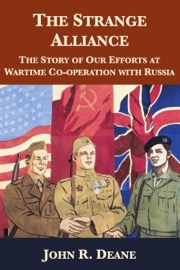
The Strange Alliance: The Story of Our Efforts at Wartime Co-operation with Russia by John R. Deane (115,000 words)
“General Deane, who was head of the United States Military Mission to the U.S.S.R. from the fall of 1943 to October 31, 1945, has set forth a personal account of his experiences in directing American attempts at military collaboration with the Soviet Union. He has written a factual, fairly objective, and generally interesting book.” — Alex Inkeles, Political Science Quarterly
“[F]or two years [John R. Deane] saw Russo-American relations from the inside. His book is a very persuasive and attractive one because he is so obviously a North American extrovert with little interest in ideologies but with a great passion for getting practical things done, and because he tells the detailed story of his long series of frustrations with such good humour and frankness... This book, in spite of its unpretentiousness or because of it, is a manual for diplomats and statesmen.” — Frank H. Underhill, International Journal
“Of the many envoys, official and unofficial, who have been sent by the United States to Russia in recent years it is doubtful that any have been more effective than ‘Russ’ Deane... He has written a book [... that...] establishes... the record of a mission with probably more accomplishments to its credit than any other since the Bolsheviki achieved their October Revolution. To mention only one of a score of notable achievements, Maj. Gen. John Russell Deane was responsible for a virtually incredible (and heretofore unrevealed) liaison between General Donovan’s OSS and the Soviet NKVD... in the account of his experience in day-to-day relationship with Russia there are assuredly valuable lessons to be learned of the possibilities of hammering out solutions acceptable to both Russia and America.” — Harrison Salisbury, The New York Times
“General Deane has written a frank and interesting book... The volume is valuable and should be widely read because of the great deal of interesting factual information it contains.” — D. Fedotoff White, The Annals of the American Academy of Political and Social Science
“General Deane went to Moscow late in 1943 to head the American military mission there, and stayed until the war was over. Despite his many disappointing experiences in trying to get coöperation from our Russian ally, he came to like the Russian people and to believe that we can get along with their hyper-suspicious government by employing a mixture of frankness and firmness. His account of what he did, saw and heard in wartime Russia is straightforward and modest.” — Robert Gale Woolbert, Foreign Affairs
“The Strange Alliance is a valuable historical record, and, at the same time, an invaluable guide to understanding Russia... a good book of historical and political value.” — Hanson W. Baldwin, Military Affairs
“This is a book to be read by all those whose interests in the problems of Soviet-American relations go deeper than the day’s headlines, and particularly by those who are inclined to the view that a sudden transformation and worsening of these relations took place when Truman succeeded Roosevelt in the presidency... The ‘strange alliance’ was an alliance against a common enemy; the breaking out of peace disclosed the lack of any other identity of purpose.” — Rupert Emerson, The Southwestern Social Science Quarterly
“[A] significant contribution to the question of present-day Russia and our relations with it.” — George Fischer, Far Eastern Survey
“This is a running description of the author’s experiences as head of the United States military mission in Moscow during the war, from 1943 to 1945. There he was brought in close contact with a number of Russian officials, and travelled widely on official business. Though his contacts were almost entirely on an impersonal level, Mr. Deane’s observations on life in Russia are of considerable interest. Of most practical significance are his reports of the inhibitions and suspicions that beset Russian dealings with foreigners, and his description of Russian methods of administration.” — Oliver J. Frederiksen, The Virginia Quarterly Review