
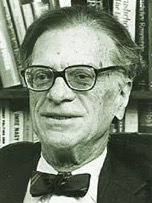
Ulam tried to enlist in the US army twice, but was rejected for having “relatives living in enemy territory” and later for myopia. He studied at Brown University and taught briefly at the University of Wisconsin–Madison. At Harvard (1944–1947), he earned his PhD for his thesis “Idealism and the Development of English Socialism”, which won the 1947 Delancey K. Jay Prize. He became a US citizen in 1949.
Ulam joined the Harvard faculty in 1947, received tenure in 1954, and was Gurney Professor of History and Political Science until his retirement in 1992. Robert Kennedy and Henry Kissinger were among his thousands of students. Ulam directed the Russian Research Center twice (1973–1974 and 1980-1992) and was a research associate at the Center for International Studies at MIT (1953–1955). He was a member of the American Academy of Arts and Sciences and of the American Philosophical Society and won many awards for his research, including a Guggenheim Fellowship (1956), Rockefeller Fellowships (1957 and 1960), and a lifetime distinguished achievement award from the American Association for the Advancement of Slavic Studies (1987).
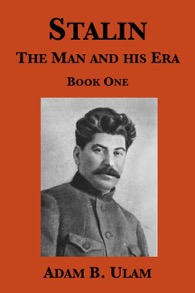
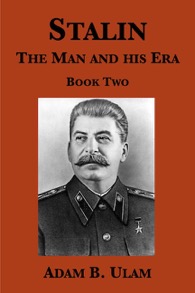
Among Ulam’s 18 books are Titoism and the Cominform (1952); The Unfinished Revolution: An Essay on the Sources of Influence of Marxism and Communism (1960); Expansion and Coexistence: The History of Soviet Foreign Policy, 1917–67 (1968); The Rivals: America and Russia since World War II (1971); Dangerous Relations: The Soviet Union in World Politics, 1970–1982 (1983) and The Communists: The Story of Power and Lost Illusions 1948-1991 (1992). His The Bolsheviks: The Intellectual and Political History of the Triumph of Communism in Russia (1965) and Stalin: The Man and His Era (1973) are generally considered the standard biographies of Lenin and Stalin.
Click on each cover for details about each eBook: