
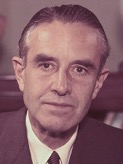
Harriman’s government career started in 1933. During World War II, he was FDR’s special envoy to Great Britain and the Soviet Union, helping coordinate the Lend-Lease program and military and diplomatic affairs between the allies. He was US ambassador to Moscow (1943-1946) and under President Truman, ambassador to London, Secretary of Commerce, and European coordinator of the Marshall Plan.
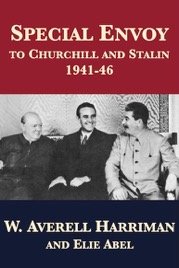
Harriman was Ambassador-at-Large under Presidents Kennedy and Johnson, negotiating the Nuclear Test-Ban Treaty in 1963 and heading the US delegation to the Paris peace talks on Vietnam. He ran unsuccessfully for the Democratic presidential nomination in 1952 and 1956 and served as Governor of New York (1955-1958). After 1969, Harriman was affiliated with various organizations, including the Club of Rome and the Council on Foreign Relations. He is the author of Peace With Russia?, America and Russia in a Changing World and with Elie Abel, of Special Envoy to Churchill and Stalin, 1941-1946.
Elie Abel
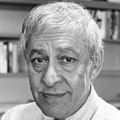
Abel left active journalism to become the Godfrey Lowell Cabot Professor and Dean of the Graduate School of Journalism at Columbia University (1970–1979). He later joined the faculty at Stanford University, where he chaired the Communications Department and directed the Stanford in Washington program.
His book The Missile Crisis was considered for many years the definitive account of the 1962 Cuban standoff. Abel coauthored Roots of Involvement: The US in Asia 1784-1871 with Marvin Kalb and Special Envoy to Churchill and Stalin, 1941-1946 with Averell Harriman.
Click on the cover for details about the eBook: