



 $12.99 on on Kindle, Nook, Apple Books, Kobo, Google Play
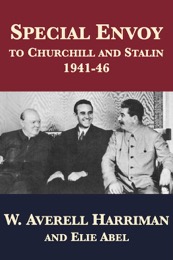
Special Envoy to Churchill and Stalin, 1941-1946 by W. Averell Harriman and Elie Abel (247,000 words, 30 illustrations)
“Mr. Harriman was Roosevelt’s personal envoy to Britain at the start of World War II. Roosevelt was already at war but the United States wasn’t, so the President needed an unofficial ambassador as well as the real one. Mr. Harriman had the title of ‘expediter,’ and he expedited himself into virtual membership in Churchill’s War Cabinet, actually attending some sessions and giving it advice. He went on to Moscow, this time with the title of ‘Ambassador.’ But few contemporary ambassadors have operated as he did, virtually as a government himself. As he writes in a foreword, with no self-belittlement but no inaccuracy either: ‘More than any other American, I had both a close personal association with Winston Churchill and intimate dealings with Josef Stalin. Of course, I had known Franklin Roosevelt since childhood.’ It would be impossible for anyone to add a great deal to the portrait of that most painted and self‐painted man, Churchill, but Mr. Harriman has a few brilliant touches.” — Richard Eder, The New York Times
“As Roosevelt’s lend-lease representative in London from 1941 to 1943 and as ambassador to the Soviet Union from 1943 to 1946, W. Averell Harriman wielded extraordinary influence. A confidant of Roosevelt and Churchill, with unusual access to Stalin, he became an intermediary among the Big Three, a man entrusted to represent the views of one to the other. In the early days of the Truman administration he played a vital role in the formulation of policy toward the Soviet Union. Now in his mid-eighties, Harriman has at last offered a full account of his service in World War II. The fruit of close collaboration with the journalist Elie Abel, Special Envoy is neither memoir nor biography. Rather, drawing heavily on Harriman’s personal papers and recollections, Abel has written a history of Big Three diplomacy from the ambassador’s perspective and offered his judgments on men and events.” — George C. Herring, The American Historical Review
“[A] significant memoir from the thinning ranks of senior participants [in World War II]... It is a story of noblesse oblige, of dedication to the commonweal... The book must stand as a basic reference on the period... should be of use and interest to all students of strategy and diplomacy.” — Robert F. Delaney, Naval War College Review
“The authors... with tireless but rarely tedious scholarship... analyze all the scenes through which Harriman moved... No one, in my opinion, will deny the contribution [Harriman] has made with this book.” — Walter Barthold, American Bar Association Journal
“Special Envoy provides an insight into the idiom of political discourse between allies in wartime and illuminates the underlying forces and interests that inform it. Through the veil of an austere prose style, emerge subtle profiles of three political titans, etched in sharp relief against a backdrop of vast movements of men, machines, and supplies across oceans and deserts... The most arresting parts of Special Envoy are its glimpses into the private personalities of the three war leaders... Winston Churchill comes through with his greatness undiminished and his humanity enhanced... Stalin, on the other hand, emerges somewhat differently from the conventional portrait. By any standard a monster in his callousness to the death and suffering of human beings, including millions of his own people, the portrait that comes through is that of a cool, tenacious, immensely capable executive, rather low-key and reserved in manner. To Harriman, the most striking and unexpected aspect of Stalin was his extraordinary grasp and comprehension of technical detail, which, with his astute sense of political psychology, made him a far more formidable negotiator than his British and American counterparts... However unstinting their admiration, the authors portray a president [Roosevelt] of distressing vanity and superficiality in his approach to foreign policy, whose principal merit seems to be willingness to accept advice of an exceptionally able team of military and civilian advisers.” — Charles Maechling, Jr., The Virginia Quarterly Review
“Elie Abel has written an important and interesting narrative based on Averell Harriman’s personal recollections, reports, and private papers. It gives a frank account of the actions of World War II and evaluates the leaders and their principal assistants. Harriman was closer to and saw more of Roosevelt, Churchill, and Stalin than any other Allied diplomat. Today’s political leaders should heed the lessons brought out by Harriman concerning dealing with the Soviets.” — The Military Engineer
“[T]he lucidity of expression and keenness of insight presented here are far beyond the commonplace. Much of the basis for the international acrimony and tumult of the past twenty-five years, through all of which Harriman has continued to participate in public service, is reconstructed here in perhaps the most thoughtful account of the War years available.” — James R. Silkenat, The Annals of the American Academy of Political and Social Science
“[T]his account provides much information in a very readable and interesting book.” — John Spanier, Political Science Quarterly
“[Abel] writes well in the best traditions of American investigative journalism, while Mr. Harriman is a figure of great interest and importance in the recent history of American foreign relations.” — Geoffrey Warner, International Affairs