


 $12.99 on Kindle, Nook, Apple Books, Kobo, Google Play
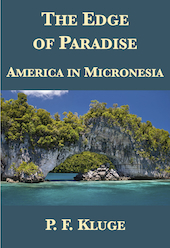
The Edge of Paradise: America in Micronesia by P. F. Kluge (86,000 words, 8 illustrations)
“Micronesia’s small islands and coral atolls are scattered over three million square miles of the western Pacific. Since their discovery by Magellan in 1521, the islands have been ruled in turn by the Spanish, Germans, Japanese and Americans. They are diverse, lovely, troubled places now trying to find their own way. P. F. Kluge... a former correspondent for The Wall Street Journal, was sent to the islands by the Peace Corps in 1967. He arrived during the American epoch, when Micronesia was called the United States Trust Territory of the Pacific Islands... He traveled widely. He got the big picture... No one has better captured the face and the feel of Micronesia in transition... Mr. Kluge’s details are sharp and so are his summary evaluations.” — Kenneth Brower, The New York Times
“[A]t heart, The Edge of Paradise is a story about, as Kluge himself puts it, ‘memory and integrity and faith’ — it’s a confession, an odyssey, a dream that threatens to turn into a nightmare.” — Jonathan Kirsch, Los Angeles Times
“...astonishing poetic flights and gritty, beery, Yankee slang. As a piece of writing The Edge of Paradise is a brilliant achievement; as analysis it is equally successful.” — Ronald Wright, Washington Post
“The Edge of Paradise is a responsible, poetic, perceptive look at an American problem that will not go away — what our national posture should be regarding the many islands of Micronesia. P. F. Kluge, with his trenchant observations as a Peace Corps volunteer a quarter of a century ago and his review of Micronesian history on recent return trips, gives a glowing account of the beauty of the islands, the tenacity of their citizens and the complexity that engulfs well-intentioned leaders who try to govern the islands. Both instructive and pleasurable, The Edge of Paradise recalled for me many exciting days in those islands and told me things I had not known. It’s a top-quality travel book.” — James A. Michener
“A lament for a dead friend, a lost paradise and a dream failed; an eloquent and beautifully written book... as much a philosophical commentary on the nature of change as a history of the Micronesian islands since their colonization by Germany, then Japan, and finally the US... A thoughtful, vivid, and moving evocation of the loss of youth’s ‘wonderful sense of possibility’ — and a politically astute commentary on American policy as well. A remarkable book.” — Kirkus Reviews
“Kluge has a good eye and is skilled at his craft. His sketches of individual Micronesians are on the mark. Whether painting a picture of Truk lagoon at night or a Marshallese waitress shuffling across the restaurant floor, Kluge captures the essence of scenes and things. He simply gets it right!... a pleasure to read.” — Robert C. Kiste, Contemporary Pacific
“[A] very well written, evocative and almost novelesque story.” — Grant McCall, Rapa Nui Journal: Journal of the Easter Island Foundation
“Absolutely the best book written about cultural imperialism, and the paradox of cultural imperialism, that I have ever read.” — Bob Shacochis, author of Swimming in the Volcano
“‘The Edge of Paradise isn’t some starry-eyed chronicle of waving palms and white-sand beaches,’ says Ransom Riggs of his former professor’s non-fiction work, written after a return to the place he served as a Peace Corps member. ‘Micronesia is a deeply complex place, and Kluge captures about as much of that as any sharp-eyed outsider can be expected to. It’s a fascinating blend of memoir, travelogue, and a noir-ish mystery, the story of Kluge returning after 20 years to unravel the tangled tale of his friend’s death. It’s an examination, too, of the lingering harm a giant nation can do to the tiny places it touches around the world.’” — Condé Nast Traveler
“The Edge of Paradise is keenly observed travel writing at its best. Shrewd and trenchant, it’s a must read for all armchair adventurers and for anyone who has ever wondered what life is like on those specks on the map that bear such names as Truk and Yap and Palau.” — Ross Thomas
“Splendid... P. F. Kluge raises the question of just what this huge vessel America leaves in its wake as it churns through the 20th century, particularly what washes up on specific small islands in the Pacific. The Edge of Paradise is structured beautifully, as a personal investigation, and never sags in human interest.” — Gregory Mcdonald